
Surprise discovery during POCUS Practice
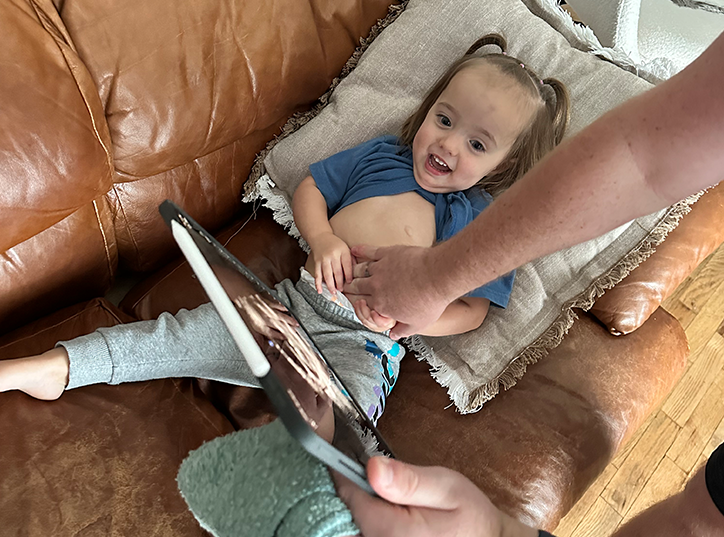
A routine moment of hands-on practice turned into something far more memorable—both professionally and personally—for second-year medical student Bryant Pace. He was practicing point-of-care ultrasound (POCUS) on his pregnant wife, Shambree, when he made a surprising discovery.
“When I put the probe on, I paused,” he said. “There were two yolk sacs. I wasn’t completely sure at first, so I reached out to a few friends and faculty to verify what I was seeing.”
The confirmation came quickly: twins!
The couple had learned to balance the demands of medical school, parenting their 2-year-old daughter, Quinn, and preparing for a new baby. Learning they were expecting twins added a new kind of energy—equal parts joy, surprise and a sense that life was about to get a lot busier.
Pace credits his ability to recognize what he was seeing to the early scanning experience he received. That foundation helped him build both the technical skills and the confidence to spot something unexpected and to trust what he saw. At Kansas City University (KCU), students in the Doctor of Osteopathic Medicine (DO) program receive their own handheld ultrasound devices, powered by Butterfly Network’s imaging technology and AI-guided feedback. That access helps them refine technique and build competency through frequent, hands-on practice—even outside the classroom and at their own speed.
KCU first introduced POCUS as an elective in 2024. The response was immediate, with more than 300 students enrolling and generating more than 16,000 scans in its inaugural year. Based on that momentum, the University expanded the offering and made POCUS a required part of the DO curriculum beginning in the 2025-26 academic year.
Built from the ground up under the leadership of Robert Arnce, MD, KCU director of clinical integration, the groundbreaking program has already begun to change how students approach clinical skill-building. Instead of waiting until residency to gain ultrasound experience, they are perfecting their scanning techniques, interpreting images and applying diagnostic reasoning long before graduation.
“By the time they reach their third year, many of our students have developed a strong command of point-of-care ultrasound, applying their skills with confidence in clinical settings,” said Arnce.
Students who develop strong POCUS skills aren’t just learning to scan; they’re learning to make faster, smarter clinical decisions in real time. That has a direct impact on patients through shorter wait times, fewer invasive or costly tests and less discomfort, especially for those in pain. Because the procedure can be done at the bedside, it often means avoiding a trip to another department for a CT scan, which can feel overwhelming for patients who are anxious or injured. In resource-limited settings, where imaging equipment may not be readily available, POCUS is particularly beneficial.
As the program has grown, Arnce has become a national subject matter expert, presenting webinars with Butterfly Network to help other institutions learn what it takes to build a scalable model of their own.
“What we’re building at KCU is a clinical skillset that directly improves patient care,” added Arnce. “As more medical schools begin to explore ways to integrate comprehensive ultrasound training into their curriculum, we’re pleased to share what we’ve learned. Our goal is to prepare students to walk into an exam room, pick up a probe and make informed decisions with full clarity.”
Pace had already begun to acquire fluency in POCUS after taking the elective course his first year of medical school, and he continues to hone his skills today. Thinking back to the day he first saw two babies on the screen, he remembers how prepared he felt—not only in capturing an accurate scan, but in understanding what he was seeing. And while he didn’t expect to make that kind of discovery at home, with the tools in his hands and the training he had received, he was ready. It was a double take he won’t soon forget.
View the coverage of the the discovery here.