
KCU students learn medicine through human connection
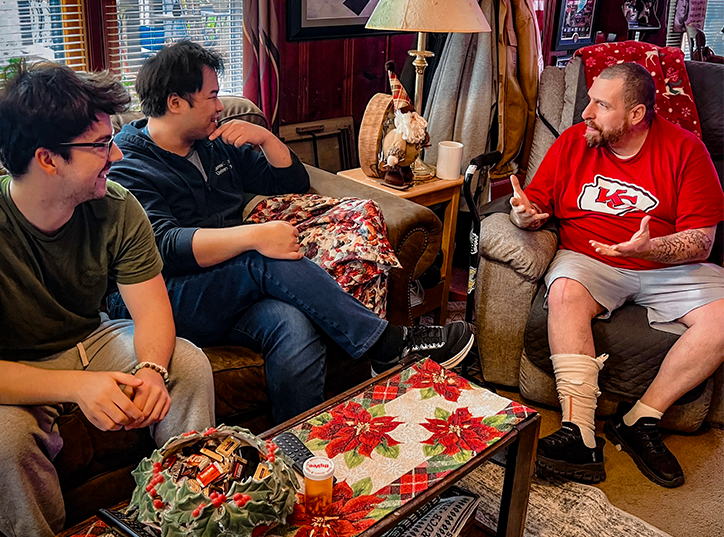
“All I want is normal.”
After surviving a devastating car accident in July 2025 that left him with multiple spinal fractures, broken ribs and legs, brain swelling and severe sepsis, Terry spent more than a month in the ICU. Recovery didn’t end when he left the hospital. It continued through rehabilitation, physical therapy and ongoing support from his family, Care Beyond the Boulevard (CBB) and KC CARE Health Center.
But healing, he says, required something more than medical treatment.
“A lot of people take normal for granted,” Terry said.
That sense of normalcy began to return through Street Wise Scholars, a new pilot program from the Center for Population Health and Equity (CPHE) at Kansas City University (KCU).
Unlike a typical medical school rotation, the initiative pairs students with participants experiencing homelessness or housing instability, called ‘scholars’ to foster understanding of the social, emotional and systemic factors that shape health long before a patient steps into a clinic.
“Street Wise Scholars was designed to give students what traditional medical education often can’t: sustained human connection,” said Benjamin Grin, MD, MPH, assistant professor of Primary Care and physician advisor for the CPHE at KCU. “This program is about learning to listen, building trust and showing up consistently.”
That connection is made possible through strong community partnerships, including CBB, a nonprofit dedicated to supporting individuals experiencing homelessness and housing instability.
“Our role is to meet people where they are and help them navigate systems not designed for them,” said Jaynell (KK) Assmann, founder and CEO of CBB. “Street Wise Scholars works because it puts dignity and humanity first. KCU students don’t just observe—they advocate. By showing up consistently, coordinating care and listening with compassion, students help participants feel seen.”
Learning beyond the classroom
In those weekly conversations, medicine is no longer theoretical, it’s human. For second-year osteopathic medical students Beatrice Antonenko, Mackenzie Kwasniewicz and Russell Schmidt, the experience has been transformative.
Antonenko says the work is deeply personal because of her own family’s experience with housing insecurity. She saw firsthand how quickly circumstances can change, reinforcing her belief that homelessness is rarely a personal failure, but the result of systemic gaps and insufficient support.
“Being part of Street Wise Scholars has reshaped how I understand barriers to care,” Antonenko said. “Long waitlists, missing documents, lack of internet access—these are real obstacles for patients. It’s not about blame; it’s about understanding and finding ways to help.”
Kwasniewicz joined the program with a desire to reconcile the tension between medicine as a business and medicine as a service.
“This program has grounded me and reminded me why I want to be a doctor,” she said. “It’s easy to get caught up in the clinical and administrative side of medicine, but seeing homelessness as a lived experience, not an abstract issue, fundamentally changes how I view my future role as a physician.”
Drawing on his experience in emergency medicine and his personal history with food insecurity, Schmidt says the program exposed him to the deep mistrust that many unhoused individuals have toward the health care system, often shaped by repeated experiences of dismissal or dehumanization.
“Physicians set the tone,” Schmidt said. “Empathy—or the lack of it—cascades. Listening first, asking broader questions and addressing what matters to the patient can make a meaningful difference.”
Meeting weekly with KCU students has allowed Terry to speak openly about his experiences in a way he doesn’t feel comfortable elsewhere. Watching the students grow alongside him, he sees them learning not just medicine, but humanity.
“They’re learning more than what’s in the classroom,” Terry said. “They’re learning what it looks like to really care.”
Learning that lasts
For Terry, having advocates in his corner restored hope at a moment when support felt scarce.
“When you go from feeling like you have no support to having that support,” he said, noting the role of his family and the program played in his recovery. “It brings life back into you.”
The impact extends well beyond Terry’s recovery. By engaging with participants over time, students gain firsthand experience with trauma-informed care, systemic inequities and patient-centered advocacy. Street Wise Scholars teaches lessons that cannot be captured in textbooks like the power of empathy, trust and consistent presence.
“Medicine doesn’t begin with a diagnosis,” Schmidt said. “It begins with listening, walking alongside patients and recognizing the humanity at the center of care.”
A model for the future
Street Wise Scholars proves that the heart of medicine isn’t just in the clinic, it’s on the streets, in homes and in the relationships built along the way. By walking with patients, listening to their stories and showing up with consistency and compassion, future physicians learn the most important lesson of all: to care as deeply as they cure.