KCU global health: Where care transcends culture
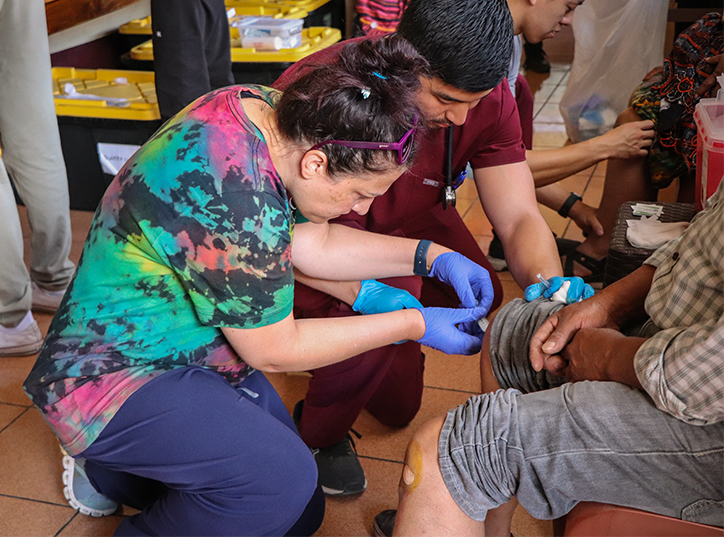
Through the KCU Global Health program, faculty, alumni and students collaborate with health care workers in remote, low-resource settings around the world – teaching, and learning, powerful lessons.
As an aspiring medical student, Allison Abraham, DO (COM 2011), was keenly interested in understanding international health care, knowing that a global lens would inform her knowledge as a future physician. While participating in a Guatemala trip during her fourth year through KCU’s Global Health program, Abraham encountered health inequities and obstacles jarringly unique from the U.S. Crediting the trip’s leader, Gautam Desai, DO, FACOFP, dist., professor and chair of Primary Care, to empower her to discover health care challenges in far-flung villages, she partnered with others to improve patients’ health and well-being.
A global education
Learning outside the classroom has become a lifelong pursuit for Abraham.
“Seeing firsthand how health disparities manifest throughout the world and the approach taken to address them helps you think critically about what doctors in nations like the United States need to effectively and safely treat patients,” said Abraham, an internist by training and an adult hospitalist in Portland, Oregon. “And it’s always striking to learn about the differences and similarities between another country’s health care system and ours.”
Since her first global health outreach experience, Abraham has embarked on more than 17 trips to Guatemala, Peru and Kenya, accompanied by students eager to become more culturally competent in medicine. One of the potent micro lessons Abraham takes from outreach trips is a reminder of why she chose medicine as her life’s work.
“It’s very instructive, practicing in an under-resourced environment outside of what you’re used to,” she said. “It helps ground you in the reason you’re in medicine, enables you to understand what colleagues across the globe are working with and helps you remember that there are many similarities, too. In essence, it enables you to grow as a physician.”
Citing the pandemic as an example, Abraham stresses the importance of physicians working together, regardless of their country, urban landscape or rural setting, to understand “how we can provide health care in different ways to achieve the same goal.”
At the core of every global outreach trip is an invaluable opportunity for shared learning and information exchange.
“Over the years, and especially with the Kenya outreach, Dr. Desai has integrated direct work with local teams,” Abraham said. “There is a partnership built on the collaboration of our knowledge and skills, allowing for educational exchange to occur between our team and the local medical teams. We learn about the diseases they commonly diagnose and how they approach treatment with the resources they have, and we can teach them new skills or approaches that they can use to improve care and teach others.”
During outreach clinics, KCU students are encouraged to apply basic skills when obtaining a patient’s history, which Abraham says builds a critical level of trust.
Desai reflects on how Abraham gives back to KCU through her dynamic involvement and mentorship in the Global Health program.
“She always spends her own money to purchase medications and spends her vacation days mentoring our students in Kenya and Guatemala. In addition to medical supervision, she also serves as an excellent role model and guides students as they navigate residency applications.”
Bringing an essential perspective into focus
Abraham is enthusiastic about the evolution of global health outreach initiatives in medical schools.
“These programs are important for students and faculty,” she said. “When I first became involved, the approach was more about ‘we are here to help,’” and now the outreach is very much about honoring the environment we’re going into and partnering for a sustainable outcome.”
Students learn firsthand the nuances of pivoting to provide care without resources typically accessible in the U.S., like labs and imaging.
“As physicians, outreach offers a global picture of how a disease affects other societies and countries and allows us to understand the public health side, too,” Abraham said. “I thrive on teaching students on an outreach trip, but love the collaboration in-country, too.”
Abraham is working in tandem with Bonyo Bonyo, DO, KCU adjunct professor, who established a clinic in Masara, Kenya, his childhood home, to bring imaging to the village.
“The Masara clinic sees a lot of patients — the physicians not only diagnose and treat, they deliver babies, test for malaria, HIV, and more but have no formal imaging,” she said. “Dr. Bonyo and I are continuing to work to try to get several of the clinic’s lead clinicians into a training program in Kenya so they can acquire an ultrasound.”
Shaping a career path
KCU student Leah Wu’s parents immigrated to the United States in the 1980s, and their background and subsequent experiences sparked her curiosity about global health.
“My mother was a health care worker,” Wu said. “My parents inspired me to pursue a medical career and my interest in global health outreach.”
Wu’s initial trip with KCU’s Global Health program was to Kenya in 2023. The fourth-year student recalls the abject poverty she observed on the journey to the village of Masara and the determination of the physicians and staff at the clinic.
“I was impressed by their resourcefulness, given the clinic’s limited technology and supplies,” she said. “The trip came when I was discouraged in my studies and lost in the books. Being in Kenya made me grateful for my privilege and training in medicine and reminded me why I wanted to become a doctor. The Masara clinic doctors had much to teach me about health care disparities and how very different health care is from what we have in this country.”
Wu’s most impactful takeaway from that trip and one to the Dominican Republic: “Health care transcends culture. Watching role models like Dr. Desai and Dr. Abraham and their passion for global outreach reinforces my approach to medicine — to be open-minded, to embrace being a lifelong learner.”