
How Kenya shaped a KCU student’s view of global health
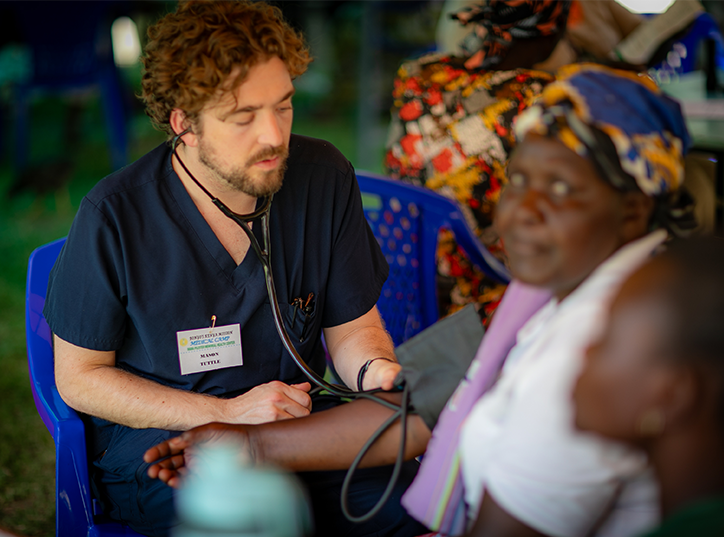
When Kansas City University (KCU) osteopathic medical student Mason Tuttle traveled to Kenya, he didn’t expect seeing two very different sides of their health care system.
Tuttle’s interest in global health first began during a study abroad experience in Madagascar, where he saw firsthand how health disparities affect communities.
“Seeing it in practice opened my eyes to health care disparities,” he said. “Even though every country is different, there are a lot of common threads.”
That experience shaped his desire to pursue medicine with a global perspective. As he prepares to enter his fourth year at KCU, Tuttle plans to specialize in anesthesiology and hopes to continue finding ways to share knowledge and resources in communities around the world.
Through the Global Health Track at KCU, Tuttle traveled to Kenya to work at Mama Pilista Bonyo Memorial Health Centre in Wan’gaya. The clinic is supported by a longstanding partnership with Bonyo’s Kenya Mission, which allows students to learn alongside local providers while contributing to efforts to expand access to care. Twice each year, KCU students and faculty physicians return to the clinic with medical supplies to support its ongoing work and provide a global health experience focused on long-term impact. Many students later return as residents and attending physicians, continuing a KCU cycle of service and mentorship.
For Tuttle, the experience offered a firsthand look at the realities of delivering care in a resource-limited setting. He encountered conditions less commonly seen in the United States, including malaria and typhoid.
“You can learn about resource constraints in a classroom, but being there and experiencing it firsthand is completely different,” he said. “I was making a difference for people there.”
But the most unexpected part of Tuttle’s experience came after the KCU Global Health trip ended.
Before traveling to Kenya, Tuttle attended an American Society of Anesthesiologists conference where he met Kenyan anesthesiologists participating in a global health panel.
“I approached them afterward and said, ‘I’m actually going to be in Kenya in six weeks. Would you be willing to show me firsthand the context you’re working in?’” he said.
With help from Global Health Track and Program Director Gautam Desai, DO, FACOFP, dist., Tuttle extended his stay in Kenya to shadow anesthesiologists at Aga Khan University Hospital in Nairobi, where he gained a closer look at his anticipated specialty in a global health setting.
Seeing both scenarios provided a more complete understanding of Kenya’s health care system and showed him that global health is not simply a story of challenges, but also one of innovation, collaboration and opportunity.
“Seeing both settings helped challenge some of my preconceived notions,” he said.
Throughout his experience, one theme continued to stand out: sustainable global health requires partnerships, education and investments that allow communities to build long-term solutions. His experience reinforced his commitment to medicine and shaped his vision for global health.
“I would rather contribute to a system that eventually leads to its own self-sustainability,” he said. “It’s not just about coming in and leaving. It’s about helping build something that continues to serve the community.”